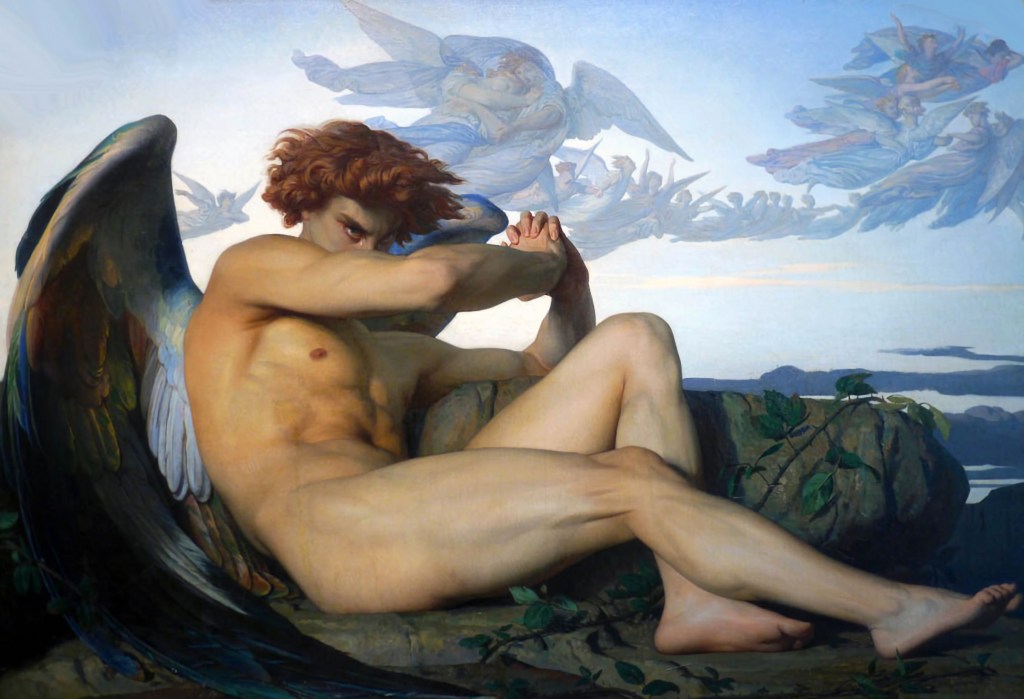
The Name Before the Fall
The name Lucifer does not mean devil. It never did.
Derived from the Latin lux (light) and ferre (to bear), Lucifer translates directly as Light Bearer or Light Bringer. The word appears in the Latin Vulgate Bible as a translation of the Hebrew helel ben shachar — “shining one, son of the dawn” — found in Isaiah 14:12. Jerome, who compiled the Vulgate in the 4th century, used Lucifer as a poetic title for the King of Babylon, a man so exalted in pride that the prophet compared his fall to that of the dawn star plummeting from the sky.
That single passage became the cornerstone of an entire mythology. A celestial being. A rebellion. A fall from grace. But the architecture of that myth obscures something far more provocative — something the occult tradition has preserved for centuries while orthodoxy looked the other way.
The same title — Morning Star — was claimed by Jesus Christ himself.
The Verse That Changes Everything
In Revelation 22:16, the resurrected Christ speaks in the first person:
“I, Jesus, have sent my angel to give you this testimony for the churches. I am the Root and the Offspring of David, and the bright Morning Star.”
The Greek here is phosphoros — literally, the light-bearer. The same cosmological role. The same celestial identity. The very title that centuries of Christian tradition had assigned exclusively to the fallen adversary.
This is not a marginal reading or a fringe interpretation. It is written plainly in the final chapter of the final book of the Christian canon. Christ is the Morning Star. Lucifer is the Morning Star. The question the esoteric traditions ask — and orthodoxy refuses to — is whether these two figures are pointing toward the same underlying cosmic principle, expressed through different mythological lenses.
What the Occult Tradition Has Always Known
The great occult authors did not shy away from this convergence. They pursued it.
Helena Petrovna Blavatsky, in The Secret Doctrine (1888), argued that Lucifer was never a proper name for evil but a symbol of divine light descending into matter to illuminate it from within. For Blavatsky, Lucifer was “the spirit of Intellectual Enlightenment and Freedom of Thought” — the sacrificial intelligence that enters the darkness of the material world as the precondition of human consciousness. The demonisation of this figure was, in her view, a deliberate suppression by ecclesiastical authority designed to keep humanity in spiritual dependency rather than self-illuminated gnosis.
Manly P. Hall, in The Secret Teachings of All Ages (1928), connected the Morning Star archetype across cultures — from Prometheus stealing fire from the gods to Venus as the dawn herald. Hall argued these were all expressions of the same primordial principle: the descent of divine light into the human mind. The Luciferian principle, properly understood, was the initiatory fire at the heart of every mystery tradition — the light that consciousness itself is made of.
Both authors were pointing at the same thing. Not Satan. Not evil. But the oldest symbol in the esoteric vocabulary: the light that descends so that something below may see.
Venus, the Dawn Star, and the Double Nature of Light
The astronomical reality beneath the mythology is instructive. The Morning Star is Venus — the same celestial body that also appears as the Evening Star. The ancients recognised this duality: the same light that heralds the dawn can also signal the coming dark. In Babylonian astronomy, Venus was Ishtar, goddess of both love and war. In Mesoamerican cosmology, it was Quetzalcoatl — the dying and resurrecting god who descends into the underworld and rises again.
The planet that precedes the sun at dawn is the same planet that follows the sun at dusk. The light-bearer who descends is the same light-bearer who ascends.
This is the esoteric core: the fall and the resurrection are the same movement. Lucifer descends into matter; Christ descends into death. Lucifer is cast from heaven; Christ empties himself of divine prerogative. In both cases, the return is triumphant — the light reclaimed, the star rising again.
The Morning Star of Revelation 22:16 is not an accident of translation. It is the text confirming what the mystery traditions encoded in symbol: the light that bears itself into darkness and the light that emerges from the tomb are aspects of the same undying fire.
The Suppression and the Preservation
The identification of Lucifer with Satan was a gradual theological construction. It was solidified through Origen’s early speculations, Gregory the Great’s 6th-century sermons, and finally crystallised in the medieval imagination through Dante’s Inferno. By the time Milton wrote Paradise Lost in 1667, the mythology was so entrenched that even a sympathetic portrayal of Satan — proud, eloquent, self-determining — could only be read as seduction.
But the mystery schools never forgot. They preserved the distinction between the light-bearer as cosmic principle and the adversarial figure of popular theology. The Rosicrucians, the Hermetic Order of the Golden Dawn, and the Theosophists all kept alive the tradition that Lucifer was the initiating fire of consciousness — the divine spark in the human being that refuses to remain unconscious.
In the Kabbalistic framework, this principle finds its home in Tiphareth — the sixth sphere on the Tree of Life, associated with the Sun, the heart, beauty, and sacrificial illumination. It is the sphere of the dying and rising god. It is also the sphere toward which the practitioner of the Western mysteries directs the Great Work. Tiphareth is simultaneously the sphere of Christ and the solar intelligence that precedes him — the light that was always there, wearing different names in different ages.
The Question the Text Raises
The Bible does not resolve this tension. It presents it.
Isaiah uses the dawn star as a metaphor for catastrophic pride and fall. Revelation uses the same image as Christ’s own declaration of cosmic identity. Peter, in his second epistle (2 Peter 1:19), uses phosphoros to describe the illumination that dawns within the heart of the awakened believer. The light-bearer, across the New Testament’s own symbolic register, is not the enemy of God. It is the light of God — descending, suffering, and rising.
What the occult tradition offers is not heresy for its own sake. It offers the preserved memory of a time before the myth hardened — when Lucifer was not a name for evil but a name for the light that dares to descend into the dark, and in doing so, makes illumination possible for everything it touches.
The Morning Star rises before the sun. It does not replace it. It announces it.
Sources: Blavatsky, The Secret Doctrine (1888); Manly P. Hall, The Secret Teachings of All Ages (1928).
 The Seat of Saints